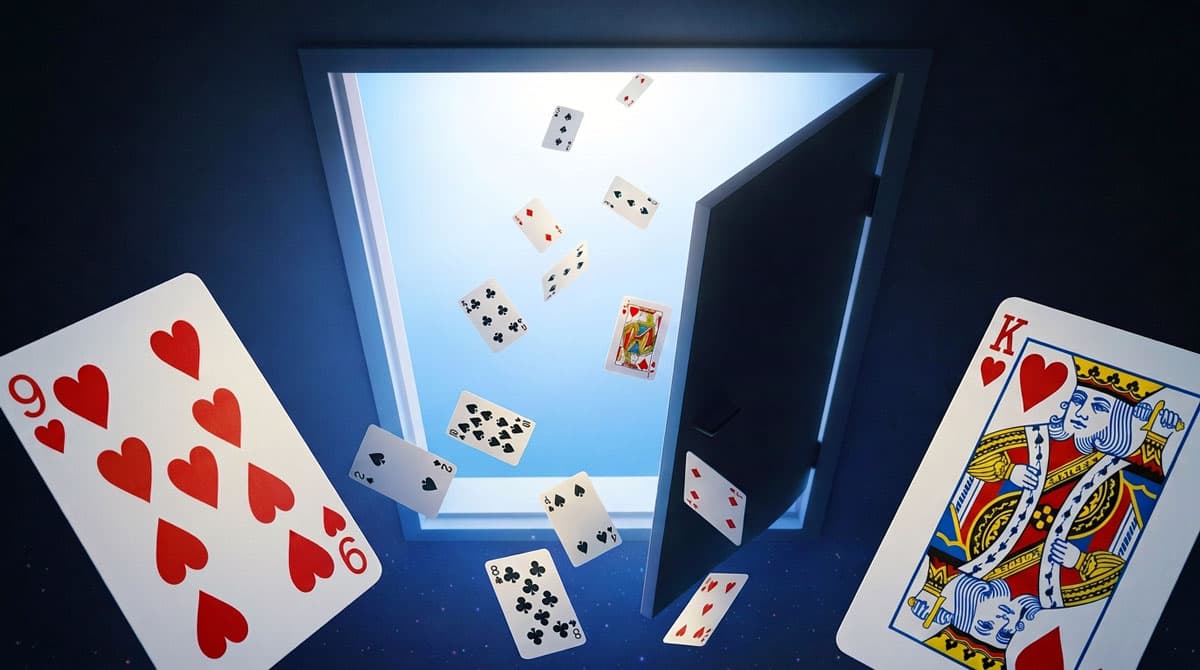
Every time you face a bet in poker, part of your range drops out.
The weakest hands cannot continue. They fall through a trapdoor.
That image matters because the process compounds. One bet filters your range. The next bet filters the smaller range that survived the first. A third bet does it again. Many expensive mistakes come from forgetting how brutal that compounding is.
When facing a bet, on average, you'll have to release something in the neighborhood of half your range. The exact number shifts with bet size and spot. If you want the precise math, see what The Three Pillars of Poker Theory has to say about minimum defense frequency. For practical play, the directional model is enough: every time you face a bet, a large chunk of your range falls away.
The implication is simple: a hand that barely cleared the bar on one street almost always starts below the line on the next if it does not improve. The leak appears when that hand keeps calling anyway. That is the Trapdoor Principle.
A Simple Example
You defend the big blind against a cutoff open. The flop comes A♠ K♥ 6♥. Cutoff bets 75% pot. You hold 6♠5♠.
Calling flop is fine. You have bottom pair with a backdoor flush draw. The hand clears the bar for one street.
The turn is the 2♦. Cutoff now bets 150% pot.
This is where players can drift into bad reasoning.
They might tell themselves they do not want to overfold in this spot and get run over. They wonder whether their opponent might be blasting draws too aggressively on this texture. They reach for blocker logic. Maybe the 5♠ unblocks bluffs. Maybe the population pushes too hard in this line.
Some of those thoughts are shaky on their own. They are also beside the point.
6♠5♠ was already near the bottom of your continuing range on the flop. The turn did nothing for you. The bet got even larger. Your hand is nowhere near the threshold now. It fell through the trapdoor. Fold and move on.
When Good Thinking Turns Against You
This mistake usually comes from players who know enough theory to make the mistake feel smart.
They know MDF. They know about blockers. They know the population can bluff too much in some nodes. They know there are spots where it's easy to overfold. Then they use those ideas to rescue a hand that never needed rescuing.
The Trapdoor Principle works as a circuit breaker. When a hand barely continued on the previous street, failed to improve, and now faces more pressure, you stop decorating the decision. The structure of the hand already did the work.
Three intelligent-sounding reasons will not resurrect a dead hand.
Every Bet Creates a Trapdoor
The principle shows up most clearly when you are calling, but it is broader than that.
A call filters your range, and a bet or raise filters your opponent's range.
When you bet flop, bet turn, and then face a river raise, the same logic is alive. Your betting range narrowed across two streets. Your opponent's calling range narrowed across two streets. Then the raise applies pressure to the range you have left.
If your hand was already weak relative to that range and the river did not improve it, the answer is usually simple. You fold.
Who placed the earlier bets does not change the principle. What matters is where your hand sits in your range when the pressure arrives.
Why This Heuristic Matters
The Trapdoor Principle will rarely show you a fold you never knew existed. Its job is to stop you from reopening a decision that was already settled one street ago. It cuts through the noise at the exact moment you are most likely to talk yourself into a mistake.
The hand fell through. Let it go.