
Expected Value, Minimum Defense Frequency, and Optimal Bluffing Frequency. These are, in my opinion, the three most important concepts in poker theory, which is why I begin all of my poker courses with them; I consider them prerequisites for teaching my students virtually anything about poker strategy.
In the era of solvers, it is possible to study poker and get better without truly understanding these concepts, but you will mostly be learning through memorization. If you only study solver outputs without understanding the fundamental reasoning behind them, you'll have a very hard time thinking for yourself in real situations.
Expected Value (EV)
Every poker player needs to know how to do a basic expected value calculation. Any time you do an EV calculation, it follows the same format:
Example
You get to the river with a pure bluff and you make a 3/4 pot bet to try to steal the pot. If your opponent folds 60% of the time, what is your expected value?
Answer
Your EV is 0.3 PSB or 30% of the pot. This bluff is significantly +EV because your opponent folds 60% of the time, above the breakeven fold frequency of 0.75 / (1 + 0.75) ≈ 42.9%.
What happens over 100 bluffs?
You bet $75 into $100. Your opponent folds 60% of the time.
Expected value per bluff
+$3,000 across 100 bluffs ÷ 100
60 folds
60 × $100 = +$6,000
40 calls
40 × −$75 = −$3,000
Actual results vary. Run a sample to see how.
Show the math
EV = (60% × $100) − (40% × $75) = +$30 per bluff.
Over 100 bluffs, the expected profit is 60 × $100 − 40 × $75 = +$3,000.
Each simulated bluff independently has a 60% chance of winning $100 and a 40% chance of losing $75. This river bluff always loses when called.
Notes
EV calculations can have more than two terms. When this is the case, the sum of the probabilities of each term must equal 100%, just like in the example above.
Minimum Defense Frequency (MDF)
Minimum defense frequency is the frequency that the defender must call and/or raise in order to keep the aggressor's bluffs from auto-profiting in a vacuum. If a player defends exactly at MDF, the opponent's bluffs will be breakeven (0 EV).
Use the following equation to calculate the minimum defense frequency facing a river bet:
Example
You get to the river with a pure bluff and you make a pot-sized bet to try to steal the pot. What is your opponent's minimum defense frequency?
Answer
Your opponent's MDF is 50%. If your opponent folds exactly 50% of the time, you will break even on this bluff; if he folds more, your bluff will be +EV; if he folds less, your bluff will be -EV.
Notes
It is common to see MDF referred to as "1 - α" where α is the fold frequency. The α symbol is pronounced "alpha."
MDF is a much simpler model than reality. In fact, a true game theory optimal defense does not make the aggressor indifferent to bluffing in a vacuum. Instead, it makes the aggressor indifferent to bluffing relative to checking.
As a result, PioSOLVER will end up defending less than MDF in all river lines. In most lines, this ends up being about 5% less than MDF. (This varies slightly depending on the bet size.) In some lines, however, PioSOLVER will defend even less than that.
Additionally, this formula only works to approximate the river. It cannot be used on the flop or turn. In the pre-solver era, no one really knew what MDF was in pre-river scenarios. However, some were able to approximate it with pretty impressive accuracy.
How often should you defend?
$100 potMinimum defense frequency
Drag to adjust your defense. The dashed line marks the minimum defense frequency, where a pure bluff breaks even.
At MDF, a pure bluff breaks even.
Show the math
MDF = pot ÷ (pot + bet) = $100 ÷ $200 = 50%
Bluff EV = (fold frequency × pot) − (defense frequency × bet)
(50% × $100) − (50% × $100) = $0
River model: the bluff always loses when defended against.
Reference Table: Minimum Defense Frequency
| Bet size / pot | MDF |
|---|---|
| 4x | 20% |
| 3x | 25% |
| 2x | 33.3% |
| 1.5x | 40% |
| 1x | 50% |
| ⅔ | 60% |
| ½ | 66.7% |
| ⅓ | 75% |
Many poker players study theory very rigidly, and they don't spend a lot of time studying what happens when an opponent deviates from the GTO strategy. As a result, they miss mathematical gems like the table below.
This table shows the EV in pot-sized bets of a bluff if the opponent defends 5% less than MDF for various river bet sizes.
| Bet size / pot | Actual folds | Breakeven folds | Bluff EV / pot |
|---|---|---|---|
| 4x | 85% | 80% | 0.250 |
| 3x | 80% | 75% | 0.200 |
| 2x | 71.7% | 66.7% | 0.150 |
| 1.5x | 65% | 60% | 0.125 |
| 1x | 55% | 50% | 0.100 |
| ⅔ | 45% | 40% | 0.083 |
| ½ | 38.3% | 33.3% | 0.075 |
| ⅓ | 30% | 25% | 0.067 |
As you can see, the EV of a bluff when facing a 5% overfold increases as the bet size increases.
One way you can think about this is: as the bet size increases, MDF decreases. Therefore, overfolding by 5% vs. an overbet is missing a larger share of MDF proportionally than overfolding by 5% to a small bet.
This is actually quite a dramatic effect. In fact, if your opponent overfolds by 5% vs. a 2x pot river bet, and by 10% to a 1/3 pot river bet, the EV of the 2x pot bluff is actually slightly higher than the EV of the 1/3 pot bluff! Most poker players assume just the opposite is true.
Optimal Bluffing Frequency (OBF)
Optimal bluffing frequency is the proportion of a player's betting range that must be bluffs in order to make the opponent's bluff catchers breakeven (0 EV) in a vacuum.
Optimal bluffing frequency is essentially the pot odds the defender is being offered, which is a function of the bet size. Optimal bluffing frequency is also the same as the defender's minimum equity required to call a bet.
If you do not understand the concept of pot odds, please look up an article about it before reading on. There are articles all over the internet which can help you with this.
Use the following equation to calculate optimal bluffing frequency vs. a river bet:
Example
Your opponent bets 1/2 pot on the river. What is his optimal bluffing frequency?
Answer
Your opponent should be bluffing 25% of the time. If your opponent bluffs exactly 25% of the time, you will break even when you call with a bluff catcher; if he bluffs more, your call will be +EV; if he bluffs less, your call will be -EV.
Notes
Like the formula for MDF, this formula only works on the river. OBF increases with each additional street left to play in the hand.
Additionally, this formula assumes the bettor's range contains only nut hands and air hands, and your range only contains pure bluff catchers. In reality, there will be more medium-strength hands in the betting and calling range, but the simplified model is still a strong approximation.
How often should you bluff?
$100 potOptimal bluffing frequency
Drag to adjust the bluff share of your betting range. The dashed line marks the optimal bluffing frequency, where a bluff catcher breaks even.
At OBF, a bluff catcher breaks even.
Show the math
OBF = bet ÷ (pot + 2 × bet) = $50 ÷ $200 = 25%
Call EV = (bluff frequency × (pot + bet)) − (value frequency × bet)
(25% × $150) − (75% × $50) = $0
River model: your bets contain only value hands and bluffs. The caller beats every bluff and loses to every value hand.
Reference Table: Optimal Bluffing Frequency
| Bet size / pot | OBF |
|---|---|
| 4x | 44.4% |
| 3x | 42.9% |
| 2x | 40% |
| 1.5x | 37.5% |
| 1x | 33.3% |
| ⅔ | 28.6% |
| ½ | 25% |
| ⅓ | 20% |
Notice that the optimal bluffing frequency is only 4% higher for a 4x pot overbet than it is for a 2x pot overbet. This is because pot odds is an asymptotic relationship. As the bet size approaches infinity, the optimal bluffing frequency approaches, but never exceeds, 50%. See the graph below for a visual representation.
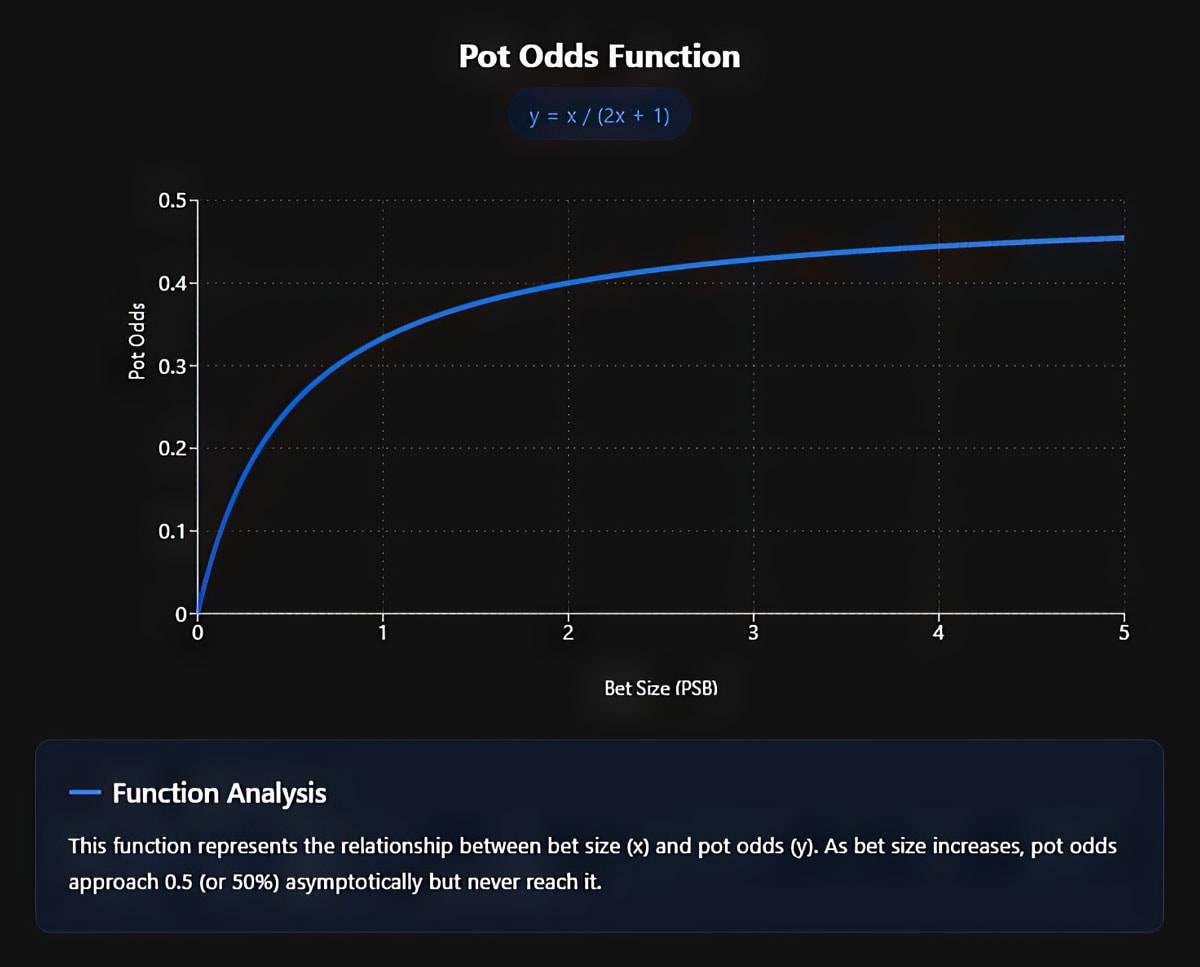
As in the previous example with MDF, we will now look at the EV in pot-sized bets of calling with a bluff catcher when facing a 5% overbluff for various bet sizes.
| Bet size / pot | Actual bluffs | Balanced bluffs | Call EV / pot |
|---|---|---|---|
| 4x | 49.4% | 44.4% | 0.450 |
| 3x | 47.9% | 42.9% | 0.350 |
| 2x | 45% | 40% | 0.250 |
| 1.5x | 42.5% | 37.5% | 0.200 |
| 1x | 38.3% | 33.3% | 0.150 |
| ⅔ | 33.6% | 28.6% | 0.117 |
| ½ | 30% | 25% | 0.100 |
| ⅓ | 25% | 20% | 0.083 |
As you can see, just like with MDF, when the margin of overbluffing remains constant, the EV of bluff catching increases as the bet size increases. Large bet sizes are not only harder to defend against, but they are also harder to balance.
Conclusion
If you understand the three pillars of poker theory, you'll be able to understand, at least on a basic level, the reasoning behind the game theory optimal strategies in any hand of poker that you study.
If you're a professional poker player, then you should be able to do these calculations in your sleep. You should have the minimum defense frequency and optimal bluffing frequency memorized for all common bet sizes. When I first started playing poker, I wrote the reference tables above on flash cards and taped them above my monitor.
Remember to not just study these concepts at equilibrium, but also to test what happens when your opponent deviates from the game theory optimal strategy. This is the key to being able to think for yourself at the poker table rather than robotically trying (and failing) to play like a solver. It will also help you become more creative in finding ways to exploit your opponents, which is where the real money in poker is made.