Put six regulars in a raked 6-max cash game and the average player is a loser.
Not because the regs are bad. Because the table has no source of money except itself, and the site is taking a cut every hand.
A 6-max cash table is an economic system. Money flows in from losing recreational players, regulars compete to capture that flow, and rake drains part of it before anyone gets paid. Once you see the game that way, game selection becomes much clearer. The real question is not “How good am I?” It is: given the rake and the lineup, where is my win rate supposed to come from?
This article focuses on 6-max no-limit hold'em cash games. All numbers are in bb/100. When I talk about rake, I mean net rake after rakeback per player. If the site rakes 5 bb/100 and you get 2 bb/100 in rakeback, the number that matters here is 3 bb/100.
The model in one line
For a first-pass estimate of table value, start here:
This is not a promise of your personal win rate. It is a baseline for the average regular, and your result moves up or down from there based on how much of the recreational loss you capture and whether you have an edge over the other regs.
A typical recreational player loses around 30-35 bb/100 including rake. Round that down to 30 bb/100 excluding the rake. That is the money flowing to the other five regs. If the net rake is 4 bb/100, then 30 ÷ 5 − 4 = +2 bb/100 for the average reg, before seat quality and skill differences sort out who gets what.
Poker is negative-sum
Poker is not like chess, where one side's gain is the other side's loss and the system itself is neutral. In a raked cash game, the system is not neutral. The site is removing money from the table all the time.
That means a table with no meaningful losing players is not just tough. It is a bad business.
If the lineup is all regulars, the average reg win rate is simply negative the rake. Some players may lose less than others, and the best reg may still grind out a small profit. But on average, the regs are paying the site for the privilege of fighting over their own money.
In many games, the question is not who the best reg is. It is whether there is enough recreational loss to keep the table above water.
Reg edges matter, but they usually do not carry the table
Reg-on-reg edges do exist. Stronger regulars do beat weaker regulars. That matters.
But in most normal lineups, those edges are not the main source of profit. Most of the money comes from recreational players making larger, simpler mistakes.
Much of what players point to as reg-battle win rates are really a modest true edge amplified by variance over a limited sample. No reg is strong enough to sustain a significant win rate in tough 6-max cash game reg battles with high rake. The edges that are realistically achievable in poker are simply not large enough. When the rake is high, recreational players are essential for the ecosystem to survive.
Why loose recreationals matter so much
The biggest mistakes in a 6-max cash ecosystem usually start preflop.
Recreational players who enter too many pots are not making one small mistake. They are creating a chain reaction. They show up with weaker ranges, in worse positions, in more multiway pots.
Loose preflop behavior drives most of the total loss rate. If recreationals moved even roughly toward sound preflop frequencies, a lot of cash-game lineups would become dramatically less profitable.
VPIP is the best predictor of loss rate
VPIP is the percentage of hands a player voluntarily puts money into preflop.
It is not a complete player model. It does not tell you who overbluffs rivers, who folds too much to 3-bets, or who stacks off too lightly postflop. But as a first-pass signal for recreational players, it is extremely useful.
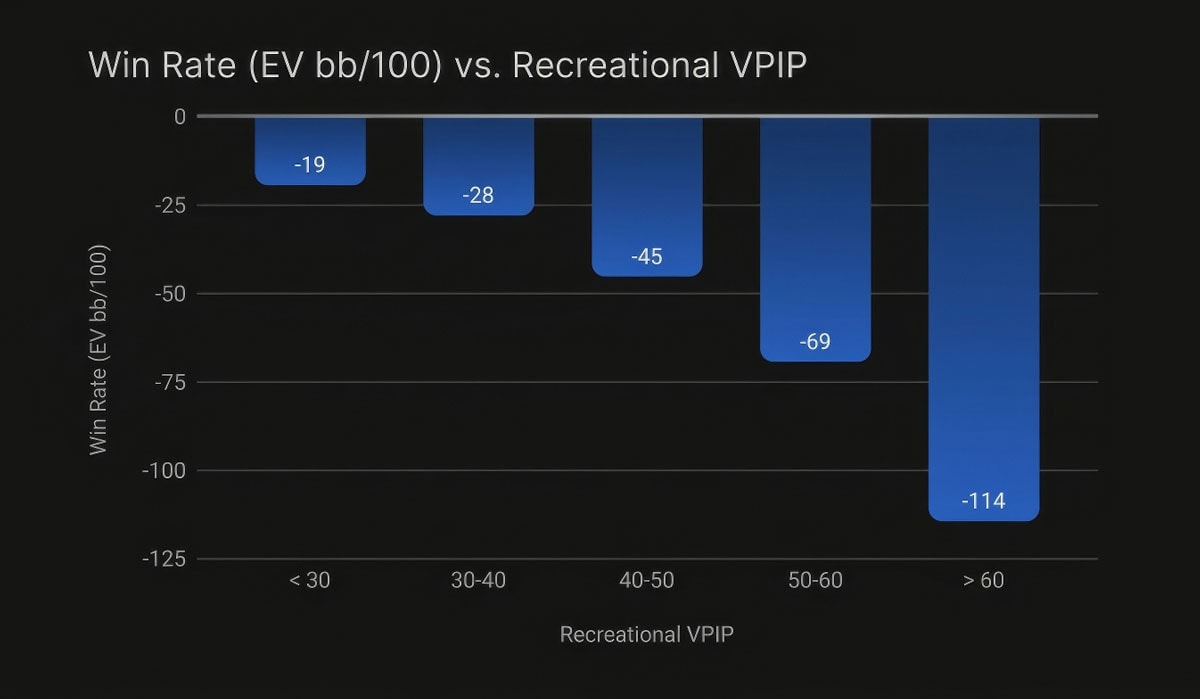
In a Hand2Note database of 200NL+ regular tables, I bucketed recreationals by VPIP. The average win rate results looked like this:
| Recreational VPIP | Average EV bb/100 | Hands |
|---|---|---|
| < 30 | -19 | 930k |
| 30 to 40 | -28 | 2.0m |
| 40 to 50 | -45 | 1.5m |
| 50 to 60 | -69 | 630k |
| > 60 | -114 | 410k |
The exact numbers will change with stack depth, rake, and postflop tendencies. But the pattern is clear: a <30 VPIP recreational and a >60 VPIP recreational do not change a table's profit margin by a little. They change it by multiples.
What the baseline looks like in practice
Here are a few simple examples.
| Lineup | Baseline math | Average reg result |
|---|---|---|
| One modest recreational losing 30 bb/100, five regs, 4 bb/100 net rake | 30 ÷ 5 − 4 | +2 bb/100 |
| No recreational, six regs, 4 bb/100 net rake | 0 − 4 | −4 bb/100 |
| One heavy recreational losing 70 bb/100, five regs, 4 bb/100 net rake | 70 ÷ 5 − 4 | +10 bb/100 |
The first row is beatable, but not by much. One modest recreational does not automatically make a game great unless the rake is very low.
The second row is the one many players do not take seriously enough. Six regs with no recreational are paying rake to fight over nothing. If the rake is moderate to high, this translates to a significant loss rate that can wipe out an otherwise solid session if you're multi-tabling.
The third row is different. One large loser can support a table in a completely different way. At an average reg win rate of 10+ bb/100, it's extremely unlikely that any of the regs would not be a substantial winner in this game—even considering that other regs could have a decent edge on them.
What happens when there are two recreationals?
This is usually a great spot, but there is one detail that makes it possible to slightly overestimate the value of these tables.
The naive version is to add both recreational loss rates, divide by the number of regs, and subtract rake, just as we did above. That is a useful starting point. But in 6-max, it usually overstates reg expectation a bit, because the two recreationals do not lose all of that money cleanly to the regs. Some of it gets redirected into each other.
When two recreationals share a 6-max table, a better estimate is to add their standalone loss rates, divide by one more than the number of regs, then subtract rake.
For example, suppose two recreationals look like roughly 30 and 45 bb/100 losers, there are four regs, and net rake is 4 bb/100. The naive version says (30 + 45) ÷ 4 − 4 = about +14.75 bb/100. A more accurate rule of thumb is (30 + 45) ÷ 5 − 4 = about +11 bb/100.
The exact discount will vary. The point is that two recreationals usually improve a game a lot, just not in a perfectly additive way.
Your seat changes how much you capture
The formula tells you whether a table is profitable in general, but it does not tell you whether your seat is good.
Not all regulars capture recreational losses equally. Position matters. If you are directly to the left of a recreational player, you will play many pots in position against them and capture a larger share of the value. If you are directly to that player's right, the opposite is true.
In real databases, I've typically observed that seat quality can swing your capture rate by roughly 20 percent. In other words, at a 6-max table where each reg is winning 6 bb/100 from the recreational player and netting 2 bb/100 on average, the best seat might be winning 3.2 bb/100, and the worst seat might only be winning 0.8 bb/100.
That is enough to matter. A table can be good overall and still mediocre from your seat. A table can also be only decent overall and become quite good if you are sitting in the right place.
What kind of lineup do you need?
The answer depends mostly on net rake.
At around 1 bb/100 of net rake, reg battling can make sense. Edges are still usually modest, but the tax is low enough that skill differences have room to matter.
At around 4 to 5 bb/100, you need at least one meaningful recreational. Not a weak reg, but someone losing fast enough to cover the rake and leave real value on the table. Reg battling in these games only makes sense in short bursts, like when you're starting a new table.
At around 8 to 10 bb/100, many lineups that feel playable are simply bad. You need two typical recreationals, or one extremely loose loser, for the game to be worth much.
High rake creates a predatory ecosystem
High rake does not just shrink win rates. It fundamentally changes which tables are rational to play in the first place. If you are not sitting with one or two clear losing players, you will slowly bleed out to the rake.
That is why these environments feel inherently predatory. In high-rake ecosystems, you are forced to either become a bumhunter or go broke.
That creates an ugly contradiction in modern online poker. Some sites build rake structures that make short-term predation the rational response, then simultaneously punish “bum hunting” or “predatory behavior” as if players created the problem on their own. They did not. The pricing created it.
Some players will still sit in these lineups because rake is an ambient fee that is easy to ignore. They get pulled into reg battles by ego and competitiveness, and they do not fully register how much money the table is bleeding every hand.
Even worse, sites like GGPoker use complicated rakeback and reward systems which make it difficult to calculate how much rake you actually pay. What feels like a tough but beatable game is often just a slow transfer to the site.
Final takeaway
Stop thinking about win rate as pure merit. In a raked cash game, it is table economics filtered through skill.
Before you sit, run the formula. How much are the recreationals likely losing? How many regulars are competing for that money? What is the net rake? If the math says the average reg is breaking even or worse, no amount of study is going to fix that table for you.
Find a better one.